Five large freezer meals with browned sous vide chicken
Yield: 5 identical complete dinners. One dinner = two heated containers + 45 g chilled light sour cream + 75 g fresh romaine. Prepare 10 frozen-base containers in total; keep the toppings refrigerated separately.
Estimated nutrition per finished dinner, including both cold toppings: about 1,760 calories, 148.7 g protein, 185.3 g carbohydrate, 51.9 g fat, 34.2 g fiber, and 1,803 mg sodium. The two frozen containers alone contain about 1,695 calories per dinner, or 848 calories per container. These are recalculated ingredient estimates using the documented reference labels and default rice quantity, not laboratory measurements. Actual product labels take precedence.
The meal: browned chicken chunks, brown rice, black beans, sweet corn, roasted peppers and onions, a smoky tomato sauce, and sharp cheddar distributed through the food. It is mildly seasoned in terms of heat, not bland. Finish each reheated dinner with 45 g light sour cream and 75 g fresh romaine, kept cold until serving. The sour cream adds a cool, tangy contrast and the lettuce stays crisp. These are included ingredients, not optional extras.
1. The chicken strategy
We are using several compatible techniques, rather than every tenderizing trick at once:
- Keep the breasts about ¾–1 inch thick, with nothing thicker than 1 inch / 25 mm. Gently flatten only the thick parts with the flat side of a mallet. A rolling pin works too. We want even pieces, not thin cutlets or damaged, ragged meat.
- Salt ahead of time. The batch gets 12 g salt on 2,250 g chicken: about 0.53% of its raw weight. This is deliberately restrained because cheese and the rest of the meal also contribute sodium. Refrigerate after seasoning for 1–4 hours; aim for 2–4 when convenient.
- Sous vide at 150°F / 65.6°C for 2 hours, subject to the thickness, starting-temperature, and circulation requirements in the method. This is a cooking-and-pasteurization step, not merely warming chicken to 150°F. [1]
- Fully chill the sealed chicken before searing. For this meal-prep recipe, the chicken does not need to be hot when it leaves the skillet. Starting cold gives you more room to brown the outside without repeatedly heating the center.
- Dry it thoroughly and sear the breasts before cutting. Brown the two broad faces, rather than trying to brown every side of dozens of little cooked cubes.
- Cut across the grain and put the chunks into a moist meal. Do not give the cooked chicken another long simmer.
- Reheat evenly, checking the temperature. The goal is to reach the recommended leftover temperature without continuing far beyond it. [4]
An honest limit: these are reheated leftovers. Bringing them to 165°F will make the breast firmer than it was straight from a 150°F sous vide bath. This method reduces avoidable overcooking; it cannot make reheated chicken identical to freshly cooked chicken. The browned exterior will become soft in the sauce, not remain crisp.
2. Shopping list for all five dinners
Weights in the “use” column control the recipe. Produce counts are shopping estimates; sizes vary. Chicken and vegetable weights are raw, trimmed edible weights. Rice is weighed dry.
| Ingredient | Buy | Use in the entire batch |
|---|---|---|
| Boneless, skinless chicken breasts | About 5½–6 lb / 2.5–2.7 kg | 2,250 g / 4.96 lb, after trimming |
| Plain long-grain brown rice | One 2-lb bag | 500 g dry, subject to the label adjustment below |
| No-salt-added black beans | Three 15-oz cans | 1,045 g beans and liquid; do not use all three cans. About 230 g stays out of the recipe. |
| Sharp cheddar, preferably a block | Two 8-oz blocks, or one 16-oz block | 300 g / 10.6 oz, grated |
| Light sour cream, not fat-free or Greek yogurt | At least 225 g / about 8 oz | 225 g total; 45 g per finished dinner. Refrigerate separately; do not freeze or heat. |
| Fresh romaine lettuce | Enough for 375 g usable leaves after trimming; a large head or a hearts multipack may work | 375 g total; 75 g per finished dinner. Refrigerate separately; do not freeze or heat. |
| Plain frozen sweet corn | At least 20 oz; two 10-oz bags work | 500 g / 17.6 oz |
| Sweet bell peppers, mostly red/orange/yellow | About 8–10 large, roughly 3½–4 lb before trimming | 1,250 g after removing stems and seeds |
| Yellow onions | About 4 large, roughly 2–2½ lb | 750 g peeled; divide into 250 g and 500 g |
| Garlic | 1 large or 2 small bulbs | 40 g peeled, roughly 8–12 large cloves |
| Limes | 4–5 | 100 g juice, approximately ⅓ cup plus 1 tbsp |
| Plain no-salt-added tomato sauce | Two 15-oz cans | 850 g, including all liquid |
| Tomato paste, no salt added | One 6-oz / 170-g can or a sufficiently large tube | 100 g, about 6 tbsp |
| Canola oil or another neutral high-heat cooking oil | A bottle, if needed | 75 g total, approximately 5½ tbsp |
| Salt | Pantry | 12 g total; weigh it |
| Pure MSG, such as Ac’cent | One small container | 4 g, approximately 1 tsp; recommended, but optional |
| Sweet smoked paprika, not hot paprika | One small jar | 18 g, approximately 2½ tbsp |
| Ground cumin | One small jar | 12 g, approximately 2 tbsp |
| Garlic powder, not garlic salt | One small jar | 6 g, approximately 2 tsp |
| Onion powder, not onion salt | One small jar | 6 g, approximately 2½ tsp |
| Dried oregano | One small jar | 3 g, approximately 1 tbsp |
| Ground black pepper | Pantry | 3 g, approximately 1¼ tsp |
| Ice | A generous supply; roughly one 10–20-lb bag if your freezer supply is limited | For active ice-water chilling; replenish as needed |
Optional: a small bunch of cilantro for serving. The meal is designed to taste complete without it.
Three shopping details that matter
Chicken: buy plain breasts without added saline solution, broth, or marinade. Check the ingredient list and sodium label rather than relying on a “natural” claim. The nutrition model uses a raw breast label of 110 calories, 25 g protein, and 55 mg sodium per 112 g. Smart Chicken currently provides one such example, but that brand is not required. [5]
Beans: buy three 15-oz no-salt-added cans, not merely reduced-sodium, but weigh out only 1,045 g of beans and liquid for the batch: 209 g per dinner. With 425-g cans, use two whole cans (about 850 g), then stir the third can gently so its beans and liquid are evenly mixed and weigh out about 195 g. Keep roughly the same beans-to-liquid ratio as in a full can. Do not just pour off 230 g liquid and retain all the beans. The remaining approximately 230 g mixed beans and liquid is not part of this recipe or its nutrition; refrigerate it promptly for another use. Can weights vary, so the scale controls the amount. The sauce will be a reddish brown, not a bright-red salsa.
Tomato sauce: this means plain U.S.-style canned tomato sauce, not ketchup or a salted pasta sauce. No-salt-added passata is a workable substitute, but its thickness and calories may differ.
Adjust the rice if your chicken label differs
Chicken labels vary enough to matter at 450 g raw chicken per dinner. Keep the chicken quantity unchanged and adjust the whole batch’s dry rice approximately as follows:
| Raw chicken label, per 112–113 g / 4 oz | Dry rice for all five meals |
|---|---|
| 100 calories | 550 g |
| 110 calories | 500 g — default recipe |
| 120 calories | 450 g |
| 130 calories | 400 g |
This holds calories near the same target using rice at about 170 calories per 45 g dry. Other ingredient labels also vary, so these are practical adjustments, not a guarantee of an exact calorie count. Do not substitute a cooked-chicken database entry for the raw package label.
3. Equipment and space
Have a sous vide circulator; heat-rated cooking bags; a vessel large enough for circulation around every bag; a kitchen scale; an instant-read food thermometer; a ruler; a flat mallet or rolling pin; a large cast-iron or stainless-steel skillet; two large rimmed sheet pans; a rice pot or rice cooker; and a large pot for the sauce and vegetables.
For cooling and storage, have shallow metal pans or bowls, a large ice-bath vessel, and 10 wide, shallow, freezer- and microwave-safe containers, ideally about 5–6 cups / 1.2–1.4 L each. Choose a wide footprint rather than a deep tub. Keep the food layer around 1–1½ inches deep, using additional containers if necessary.
Clear refrigerator and freezer space before cooking. This is several kilograms of food: do not count on a crowded refrigerator or a stack of deep, hot containers to cool it quickly. Shallow portions and ice-bath cooling are especially useful at this scale. [6]
If the sous vide vessel cannot hold all the bags with water circulating between them, cook in batches. Keep uncooked bags refrigerated, and chill the cooked batch promptly rather than leaving it on the counter.
4. Measure and divide the ingredients before starting
This prevents accidentally using the full oil or seasoning allowance more than once.
A. Chicken
- 2,250 g raw trimmed chicken breasts
- 12 g salt — all the recipe’s baseline added salt
- 6 g garlic powder
- 6 g onion powder
- 1 g of the black pepper
- 25 g of the oil, reserved for the later sear
B. Rice
- 500 g dry brown rice, or the adjusted amount from the label table
- Water according to that rice’s package or rice-cooker directions
- No added oil, butter, broth, or salt
C. Roasted vegetables
- 1,250 g trimmed bell peppers
- 250 g of the peeled onions
- 30 g of the oil
D. Smoky bean-and-corn sauce
- Remaining 500 g peeled onion, finely diced
- Remaining 20 g oil
- 40 g garlic, finely chopped or grated
- 100 g tomato paste
- 18 g sweet smoked paprika
- 12 g ground cumin
- 3 g dried oregano
- Remaining 2 g black pepper
- 850 g no-salt-added tomato sauce
- 1,045 g no-salt-added black beans and liquid, weighed as described above; buy three cans but leave approximately 230 g unused
- 500 g plain frozen corn
- 4 g MSG, optional but recommended
- 100 g fresh lime juice
- 200 g / about ¾ cup plus 1 tbsp water initially; more only as needed
E. Cheese
- 300 g grated sharp cheddar
- Divide into 10 portions of 30 g, or five portions of 60 g
F. Cold toppings — keep out of the freezer containers
- 225 g light sour cream: 45 g per finished dinner; use actual light sour cream, not fat-free sour cream or Greek yogurt
- 375 g usable romaine leaves: 75 g per finished dinner, weighed after trimming
- Keep both refrigerated separately at 40°F / 4°C or colder. Do not freeze them with the meals and do not microwave or bake them.
MSG is included for savory flavor without relying entirely on more table salt. It still contains sodium, which is included in the sodium estimate. [7]
5. Cooking method
Step 1 — Trim, even out, and season the chicken
Work on a raw-chicken cutting board. Trim away obvious fat, cartilage, and tough tendons. Weigh out 2,250 g after trimming. Do not rinse the raw chicken.
Place each breast inside a separate sturdy bag used for pounding, or between protective sheets. Gently flatten its thickest area with the flat side of a mallet until it is around ¾–1 inch thick. Measure the thickest part: no piece should exceed 25 mm / 1 inch. If a breast is exceptionally thick, cut it horizontally into substantial pieces before gently evening them out. Do not pound the thin tapered end into paper.
Mix the 12 g salt, 6 g garlic powder, 6 g onion powder, and 1 g pepper. Distribute evenly over both sides of all the chicken. Do not add additional salt by eye.
Transfer to fresh cooking bags, in a single layer. One or two breasts per bag is fine when they lie side by side; do not stack them. Remove excess air and seal. Keep refrigerated at 40°F / 4°C or colder for 1–4 hours. There is no oil, butter, lime juice, or baking soda inside these bags.
Wash and sanitize the raw-chicken work area, utensils, and hands before handling cooked food.
Step 2 — Cook the chicken sous vide
Preheat the bath to 150°F / 65.6°C. Add the refrigerator-cold, unfrozen bags, with the meat fully submerged and space for water to circulate around every bag.
When the bath has recovered to 150°F, start a 2-hour timer. Keep it at that temperature throughout. Prevent bags from floating, overlapping, or packing tightly around the circulator.
This schedule assumes the specified maximum 1-inch thickness and refrigerator starting temperature. Baldwin’s poultry tables explicitly account for both heating and pathogen reduction; the two-hour schedule gives margin beyond the table’s requirement for this thickness at 149°F. It is not a schedule for frozen chicken or several breasts stacked into one thick block. [1]
Make the rice, vegetables, and sauce during this period. Each component should move into cooling promptly when finished; it need not wait for the chicken.
Step 3 — Cook and promptly cool the rice
Cook the measured dry rice according to its package or your rice cooker’s brown-rice instructions, using plain water. Do not add the sauce, beans, or chicken during rice cooking. Different brown-rice varieties need different amounts of water and time, so use the package rather than a universal ratio.
Aim for grains that are cooked through but not mushy. Fluff after the instructed rest.
Weigh the finished rice and divide by 10. Put that weight into each storage container, in a thin layer. Promptly refrigerate with lids loosely positioned while it cools; do not leave the pot sitting out until every other component is ready. Alternatively, cool the rice in shallow pans, then portion it cold. [4,6]
The rice’s cooked weight will vary with water absorption. Use all the rice made from the specified dry amount; do not substitute a fixed cooked weight.
Step 4 — Roast the peppers and some onion
Heat a conventional oven to 425°F / 220°C. Cut the 1,250 g peppers and 250 g onion into roughly ¾–1-inch pieces or short, broad strips.
Toss with 30 g oil. Spread across two large rimmed sheet pans. Avoid deep piles; use a third pan or another roasting round if necessary.
Roast approximately 25–35 minutes, turning once and rotating the pans as needed. Look for soft vegetables with browned edges, not blackened onion scraps. Time is a starting point; crowding and oven strength matter.
Do not add extra oil or salt automatically. The finished meal also contains the seasoned chicken, sauce, and cheese.
Step 5 — Make the smoky sauce
While the vegetables roast, heat 20 g oil in a large pot over medium heat. Add the 500 g finely diced onion. Cook about 10–15 minutes, stirring, until soft with some golden color. If it sticks before softening, add a small splash of water rather than another pour of oil.
Add the 40 g garlic and cook about 45–60 seconds. Stir in 100 g tomato paste and cook another 2 minutes, stirring to darken it slightly without scorching.
Turn the heat down. Add the 18 g smoked paprika, 12 g cumin, 3 g oregano, and remaining 2 g pepper. Stir for only 20–30 seconds, then immediately add the tomato sauce and the initial 200 g water. Do not let the dry spices sit in a smoking-hot pot.
Add the measured 1,045 g beans and liquid, the 500 g frozen corn, and 4 g MSG. Use only the weighed bean portion, not all the contents of the three purchased cans. Simmer gently, stirring periodically, for approximately 10–15 minutes, until the corn is cooked and the ingredients are well combined. Follow any longer cooking instruction on the corn’s package.
Fold in the roasted peppers and onions, including any non-burnt pan juices. Take the pot off the heat and stir in the 100 g lime juice.
The reduced bean quantity can change the sauce thickness. Keep the existing water allowance as a starting point and adjust only the water to reach the target below; do not add extra oil, cheese, or another calorie-dense ingredient to make up for the beans.
The consistency target: a generous, spoonable, moist mixture that coats the vegetables and beans. A spoon dragged through it should leave a track that fills back in, not a dry trench. It should not have a large pool of watery liquid. Add water in 50 g / roughly 3 tbsp increments when too thick; simmer a little longer without the chicken when too thin.
Do not judge the final salt level from the bean-and-vegetable mixture alone. It is meant to be eaten with salted chicken and cheese. Do not add a seasoning packet, bouillon cube, bottled queso, or extra chili powder blend.
Step 6 — Actively cool the sauce and vegetables
Transfer the mixture from the deep cooking pot into shallow metal bowls or pans. Nest them in ice water, keeping bath water out of the food. Stir the food occasionally with a clean utensil; replenish ice.
Move into the refrigerator as space and temperature allow. Do not wait on the counter for the mixture to reach room temperature. Keep it cold while the chicken finishes.
For this large batch, use a thermometer and the FDA’s two-stage cooling benchmark: 135°F to 70°F within 2 hours, then to 41°F or below within 6 hours total. Aim to get there substantially sooner with ice baths and shallow portions. During refrigerator cooling, leave lids loose and allow air circulation; seal once cold. [6]
Step 7 — Chill the sealed chicken before browning it
When its two-hour cook is complete, move the sealed bags immediately into an actively icy water bath, with plenty of water contacting every bag. Use at least roughly half ice by volume, and add ice as it melts.
For the specified breasts no thicker than 1 inch, plan on at least 60 minutes in that properly maintained bath. Baldwin estimates about 50 minutes to 41°F for a 25-mm slab under the stated ice-bath conditions; this recipe allows extra time. [1]
On this first batch, open the thickest piece’s bag and verify the center is 40°F / 4°C or colder with a clean thermometer before treating it as refrigerated food. If it is warmer, rebag that piece in a clean sealed bag and continue chilling. Never assume that a cool-feeling bag means the center is cold.
Keep the other bags sealed and cold until you are ready to sear. This cooling step is deliberate, not a mistake: the skillet is now just for flavor and browning.
Step 8 — Dry and sear the cold breasts
Open only the bags you are about to work with. Discard the bag liquid for this recipe. The nutrition estimate conservatively counts the full raw-chicken amount and all added salt rather than subtracting uncertain losses in that liquid.
Pat the chicken very dry with paper towels. Remove wet clumps of seasoning; do not rinse. Use a clean plate and cooked-food utensils.
Preheat a large cast-iron or stainless-steel skillet over medium-high to high heat. Add a little of the reserved 25 g oil. It should shimmer; you do not need clouds of smoke. Ventilate the kitchen.
Sear one or two breasts at a time, leaving space between them. Press lightly for the first few seconds to make contact. Start with roughly 45–60 seconds on the first side and 30–60 seconds on the second, stopping when the broad surfaces have good golden-brown patches. Adjust the pan heat rather than turning the sear into several more minutes of cooking.
Distribute the 25 g oil across the batches. Let the pan recover its heat between batches, and remove burnt residue rather than letting it coat the next breast. Do not use additional butter, sugar, or a fresh paprika crust during this high-heat step.
Do not try to brown every surface. After cutting, each chunk may have one browned face and pale cut faces. That is the desired result. You are not trying to heat the center to 165°F during this brief finishing sear; the chicken was already cooked and pasteurized, and will be safely reheated as a finished meal later.
Step 9 — Cut, portion, and add cheese
Let each seared batch sit for 3–5 minutes on a clean board, not indefinitely while you finish the whole kitchen. Cut across the visible muscle grain into thick strips, then into roughly ¾–1-inch / 2–2.5-cm chunks. Keep clean board juices with the chicken.
Weigh the cooked chicken and divide into 10 equal portions. Weigh the cooled sauce-and-vegetable mixture and divide into 10 equal portions. Each container already has one-tenth of the rice.
For each frozen-base container (no sour cream or lettuce):
- Add one-tenth of the chicken and one-tenth of the sauce mixture to the rice.
- Gently fold together so the chicken is coated and there are no dry rice pockets. Do not mash the beans or shred the chicken.
- Mix in 15 g cheddar, then scatter another 15 g over the top.
The cheese does not have to melt now. It will melt during reheating. Do not simmer the chicken again or bake the entire batch just to melt the cheese before freezing.
Taste a small combined sample with rice, chicken, sauce, and cheese. For adjustment, try a little additional lime first if it tastes dull. If you truly need more salt, weigh the addition: 1 extra gram across the entire batch adds about 79 mg sodium per dinner. The baseline nutrition does not include extra salt.
Step 10 — Finish chilling and freeze
Promptly return assembled containers to the refrigerator, in a single layer with space for air, until the centers are 40°F / 4°C or colder. Keep food shallow and lids loose while cooling, protected from contamination. Do not stack warm containers. [4,6]
Once cold, close tightly, label, and freeze the portions intended for later days. Keep the freezer at 0°F / −18°C or below. Freeze containers in a single layer initially; stack after they are frozen solid. [8]
Label the pairs Dinner 1 A/B, Dinner 2 A/B, and so on. Mark each container “½ frozen base — about 848 calories / 72.4 g protein; cold toppings not included.” Label each dinner pair “2 containers + 45 g light sour cream + 75 g romaine = 1 finished dinner, about 1,760 calories.” The topping quantities are for the full dinner, not each container.
You can refrigerate the first dinner and freeze the other four. Use any refrigerated portion within 3–4 days, not five or six. Freeze the later meals on prep day rather than waiting several days first. [4]
Step 11 — Store the cold toppings separately
Keep 225 g light sour cream covered in the refrigerator, using 45 g per dinner and following the package storage and use-by directions. Do not portion it into the freezer meals.
Trim the romaine and allow for outer-leaf and core losses when buying it. Have 375 g usable leaves for five dinners. For lettuce that is not labeled prewashed or ready-to-eat, rinse under running water, then dry thoroughly with a clean towel or salad spinner. Follow ready-to-eat package instructions; do not use soap or detergent. [15]
Store as whole, thoroughly dried leaves or hearts in a clean covered container or produce bag with a clean dry paper towel. Keep at 40°F / 4°C or colder, separate from raw chicken and its juices. Chop the 75 g daily portion on eating day when practical; this helps preserve crispness through the five-day plan. Follow the package date and condition of the leaves rather than treating five days as a guaranteed shelf life. Replace spoiled or slimy leaves. Do not freeze the romaine.
6. Reheating on eating day
Easiest on texture and timing: thaw in the refrigerator first
Move a dinner’s two containers to the refrigerator about a day before eating. They may need longer if the containers are thick or the refrigerator is especially cold. Partly frozen centers simply need extra heating; do not finish thawing on the counter.
Reheat one container at a time:
- Add 1–2 tbsp water around the edges and cover with a microwave-safe, vented lid.
- Start with 3 minutes at about 70% power in a roughly 1,000-W microwave.
- Stir from the edges to the center, turning over chicken pieces and distributing the melted cheese.
- Continue in 1-minute intervals, stirring and checking, until the food reaches 165°F / 74°C throughout.
- Let stand covered for 2 minutes, then check several locations with a thermometer, including the center and a large chicken chunk. Heat again if there is a cold spot. [4]
This is still a very large half-dinner (roughly 23 g less bean mixture per frozen container than before; use its actual packed weight), so expect more time than a small commercial meal. The time is not the safety test; the thermometer is.
Directly from frozen: no advance planning required
The assembled meal can also be reheated from frozen. It will take longer, and the outer edges need protection from overheating while the center thaws. [8]
For each container, add 2 tbsp water, cover with a vented microwave-safe lid, and start with 5 minutes at 50% power. Break up and stir whatever has softened. Continue at 50% in 2-minute intervals until it is possible to stir through the center. Then finish at about 70% power in 1-minute intervals, stirring, until it reaches 165°F throughout. Rest covered and check again as above.
Treat these intervals as a starting procedure, not a promise that a particular number of minutes will work. A complete two-container frozen base is not realistically a guaranteed 5–10-minute microwave job. Heating the two halves separately may take considerably longer; eat the first while the second heats if that suits you. In that case, split the full dinner’s cold toppings between them: 22.5 g sour cream and 37.5 g romaine per half, with no second full topping allowance.
Avoid continuing until the sauce has been violently boiling for several minutes. Covered, interrupted heating plus stirring and temperature checks is the approach here—not a single long blast.
Oven alternative
For less stirring but a longer wait, place the food in a suitable oven-safe dish, add a splash of water, and cover. Heat at 350°F / 175°C, stirring when the center softens, until it reaches 165°F throughout. Start checking around 30 minutes if thawed, and expect substantially longer from frozen. Dish shape and depth matter too much for a universal finish time.
Do not put plastic storage containers in the oven. Do not put a frozen glass dish into a hot oven unless its manufacturer explicitly permits that temperature change.
Finish each dinner after reheating
- Thaw or reheat both frozen-base containers using the unchanged methods above. Stir, let stand, and check that the food reaches 165°F / 74°C throughout, including several locations and a large chicken piece.
- Transfer the hot food to a large bowl or plate, or serve from the reheating containers if preferred.
- Add 45 g chilled light sour cream across the full dinner.
- Add 75 g fresh romaine, shredded or chopped into bite-sized pieces, across the full dinner.
- Eat immediately. Keep the lettuce cool and crisp, with cool sour cream against the hot food. Neither topping goes in the microwave or oven.
One finished dinner = two heated containers + 45 g light sour cream + 75 g romaine. If serving the two halves separately, use 22.5 g sour cream + 37.5 g romaine per half. Do not double the topping quantities. Adding already-prepared toppings should take less than a minute; allow a little longer when chopping lettuce.
7. Nutrition calculation and logging
The following is a fresh ingredient-based calculation using the default 500 g dry rice, 1,045 g beans and liquid, unchanged 300 g cheddar, and the two required cold toppings. All 75 g oil, the full raw-chicken allocation, all 12 g salt, and the optional 4 g MSG are counted. Nothing is subtracted for uncertain bag-juice or pan losses. Totals are added before rounding.
Finished dinner versus frozen base
| Portion | Calories | Protein (g) | Carbs (g) | Fat (g) | Fiber (g) | Sodium (mg) |
|---|---|---|---|---|---|---|
| Finished dinner: 2 containers + 45 g sour cream + 75 g romaine | 1,760 | 148.7 | 185.3 | 51.9 | 34.2 | 1,803 |
| Frozen base for 1 dinner: 2 containers, no toppings | 1,695 | 144.7 | 181.3 | 47.9 | 32.6 | 1,775 |
| 1 frozen half-dinner container, no toppings | 848 | 72.4 | 90.7 | 24 | 16.3 | 887 |
| Half a finished dinner: 1 container + 22.5 g sour cream + 37.5 g romaine | 880 | 74.3 | 92.6 | 25.9 | 17.1 | 902 |
| Cold toppings for 1 dinner only | 65 | 3.9 | 4 | 4 | 1.6 | 29 |
| Whole 5-dinner batch, including cold toppings | 8,802 | 743.3 | 926.5 | 259.4 | 171.1 | 9,017 |
The frozen containers contain the cooked components and cheddar only. Light sour cream and romaine are included once in finished-dinner nutrition and excluded from frozen-base nutrition. The two cold toppings add 65 calories per full dinner; their separate contributions are 52.5 calories from 45 g light sour cream and 12.75 calories from 75 g romaine.
Component breakdown per finished dinner
| Component per finished dinner | Quantity | Calories | Protein (g) |
|---|---|---|---|
| Chicken breast, raw | 450 g raw | 442 | 100.4 |
| Brown rice, dry | 100 g dry | 378 | 6.7 |
| No-salt-added black beans and liquid | 209 g | 161 | 9.6 |
| Sharp cheddar | 60 g | 236 | 15 |
| No-salt-added tomato sauce | 170 g | 69 | 2.7 |
| Corn, sweet, yellow, raw | 100 g | 86 | 3.3 |
| Peppers, sweet, red, raw | 250 g | 65 | 2.5 |
| Onions, raw | 150 g | 60 | 1.6 |
| Garlic, raw | 8 g | 12 | 0.5 |
| Lime juice, raw | 20 g | 5 | 0.1 |
| Tomato products, canned, paste, without salt added (Includes foods for USDA's Food Distribution Program) | 20 g | 16 | 0.9 |
| Oil, canola | 15 g | 133 | 0 |
| Salt, table | 2.4 g | 0 | 0 |
| Spices, paprika | 3.6 g | 10 | 0.5 |
| Spices, cumin seed | 2.4 g | 9 | 0.4 |
| Spices, garlic powder | 1.2 g | 4 | 0.2 |
| Spices, onion powder | 1.2 g | 4 | 0.1 |
| Spices, oregano, dried | 0.6 g | 2 | 0.1 |
| Spices, pepper, black | 0.6 g | 2 | 0.1 |
| MSG (optional, included in estimate) | 0.8 g | 3 | 0 |
| Light sour cream — cold topping | 45 g | 53 | 3 |
| Fresh romaine — cold topping | 75 g | 13 | 0.9 |
The black-bean allocation is 209 g per dinner, down from 255 g: a 46 g / 18.04% reduction. Exact 18% reduction would give 209.1 g; this recipe uses the requested rounded 209 g. With the verified 100-calorie / 130-g bean label, that removes about 35.4 calories, 2.1 g protein, 6.7 g carbohydrate, 0.2 g fat, 2.1 g fiber, and 5.3 mg sodium per dinner. The previous 110-calorie label would instead imply about 38.9 calories removed. The same proportional bean reduction is applied to every nutrient, including the small sodium contribution.
Reference labels and calculation assumptions
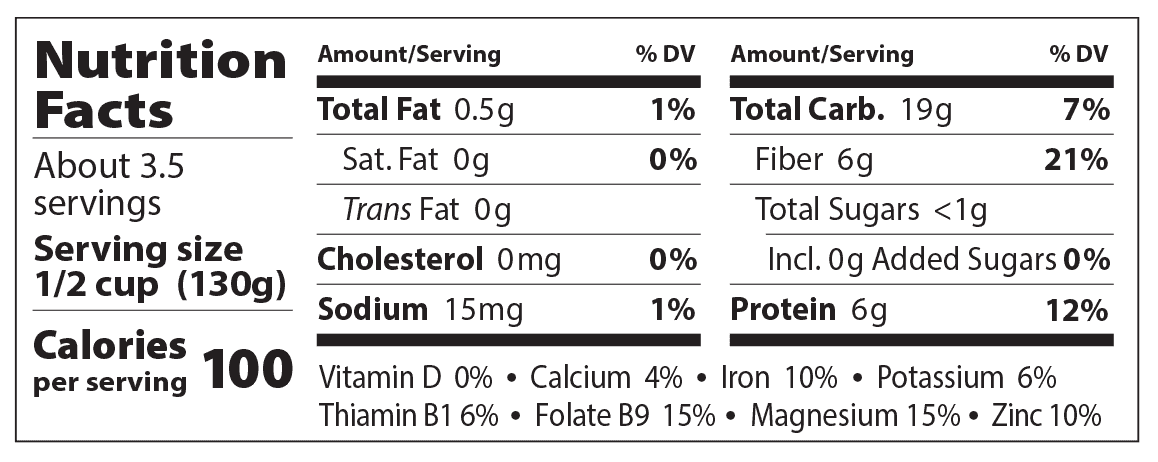
Actual packages take precedence. Manufacturer labels checked for this update: Smart Chicken raw breast 110 calories, 25 g protein, 1.5 g fat, 55 mg sodium per 112 g; Lundberg rice 170 calories, 3 g protein, 34 g carbohydrate, 1.5 g fat, 2 g fiber per 45 g dry; Eden beans 100 calories, 6 g protein, 19 g carbohydrate, 0.5 g fat, 6 g fiber, 15 mg sodium per 130 g including liquid; Sargento cheddar 110 calories, 7 g protein, 9 g fat, 190 mg sodium per 28 g; Hunt’s no-salt-added sauce 25 calories, 1 g protein, 5 g carbohydrate, 2 g fiber, 15 mg sodium per 62 g. [5,9–12]
Light sour cream: the Daisy Light manufacturer package shown on its site gives 35 calories, 2 g protein, 1 g carbohydrate, 2.5 g fat, no fiber, and 15 mg sodium per 30 g. At 45 g per dinner, that is 52.5 calories, 3 g protein, 1.5 g carbohydrate, 3.75 g fat, no fiber, and 22.5 mg sodium. This is actual light sour cream, not fat-free sour cream or a yogurt substitute. Other labels may give 40 calories per 30 g; that would add 7.5 calories per dinner to this estimate. [13]
Romaine: USDA SR Legacy lists 17 calories, 1.23 g protein, 3.29 g carbohydrate, 0.3 g fat, 2.1 g fiber, and 8 mg sodium per 100 g. The 75 g dinner portion contributes 12.75 calories, 0.92 g protein, 2.47 g carbohydrate, 0.23 g fat, 1.58 g fiber, and 6 mg sodium. [14]
Why the result differs from the example near 1,790: the old 1,760-calorie figure was rounded and used different reference entries. The current bean label is 100 instead of 110 calories per 130 g. The new sour cream label is 35 per 30 g, and the USDA red-pepper entry used here is 26 instead of the old 31 calories per 100 g. With the same current references, the old bean quantity without toppings would calculate to about 1,731 calories; subtracting about 35 for the bean reduction and adding 65.25 for the cold toppings gives about 1,760 calories. Its similarity to the old rounded 1,760 is coincidental. The new totals were not forced to match either number.
For produce, oil, table salt, and spices, the model uses the April 2018 USDA SR Legacy dataset, with individual food IDs and all six nutrient values recorded in the calculation data. Generic paprika and cumin entries stand in for sweet smoked paprika and ground cumin; raw sweet yellow corn is the generic proxy for plain frozen corn, as in the original calorie model. These are estimates rather than promises about a particular brand or crop. [14]
Sodium: the calculation includes natural sodium, all 12 g table salt, approximately 492 mg sodium from the batch’s 4 g MSG, and all label sodium. MSG has an explicit conservative energy allowance of 4 calories per gram of glutamate, counted separately from protein; tiny label servings can round to zero. Omitting the optional MSG removes about 3 calories and 98 mg sodium per dinner. Do not subtract imaginary salt losses in discarded chicken juices. Salted beans, enhanced chicken, regular tomato sauce, and extra seasoning can raise sodium substantially.
Full nutrient inputs for checking your labels
Each row below gives the values for the stated reference serving, not the amount used in the recipe. All gram amounts in the ingredient tables still control the batch.
| Reference food | Reference serving | Calories | Protein (g) | Carbs (g) | Fat (g) | Fiber (g) | Sodium (mg) |
|---|---|---|---|---|---|---|---|
| Chicken breast, raw | 112 g | 110 | 25 | 0 | 1.5 | 0 | 55 |
| Brown rice, dry | 45 g | 170 | 3 | 34 | 1.5 | 2 | 0 |
| No-salt-added black beans and liquid | 130 g | 100 | 6 | 19 | 0.5 | 6 | 15 |
| Sharp cheddar | 28 g | 110 | 7 | 0 | 9 | 0 | 190 |
| No-salt-added tomato sauce | 62 g | 25 | 1 | 5 | 0 | 2 | 15 |
| Corn, sweet, yellow, raw | 100 g | 86 | 3.27 | 18.7 | 1.35 | 2 | 15 |
| Peppers, sweet, red, raw | 100 g | 26 | 0.99 | 6.03 | 0.3 | 2.1 | 4 |
| Onions, raw | 100 g | 40 | 1.1 | 9.34 | 0.1 | 1.7 | 4 |
| Garlic, raw | 100 g | 149 | 6.36 | 33.06 | 0.5 | 2.1 | 17 |
| Lime juice, raw | 100 g | 25 | 0.42 | 8.42 | 0.07 | 0.4 | 2 |
| Tomato products, canned, paste, without salt added (Includes foods for USDA's Food Distribution Program) | 100 g | 82 | 4.32 | 18.91 | 0.47 | 4.1 | 59 |
| Oil, canola | 100 g | 884 | 0 | 0 | 100 | 0 | 0 |
| Salt, table | 100 g | 0 | 0 | 0 | 0 | 0 | 38,758 |
| Spices, paprika | 100 g | 282 | 14.14 | 53.99 | 12.89 | 34.9 | 68 |
| Spices, cumin seed | 100 g | 375 | 17.81 | 44.24 | 22.27 | 10.5 | 168 |
| Spices, garlic powder | 100 g | 331 | 16.55 | 72.73 | 0.73 | 9 | 60 |
| Spices, onion powder | 100 g | 341 | 10.41 | 79.12 | 1.04 | 15.2 | 73 |
| Spices, oregano, dried | 100 g | 265 | 9 | 68.92 | 4.28 | 42.5 | 25 |
| Spices, pepper, black | 100 g | 251 | 10.39 | 63.95 | 3.26 | 25.3 | 20 |
| MSG (optional, included in estimate) | 1 g | 4 | 0 | 0 | 0 | 0 | 123 |
| Light sour cream — cold topping | 30 g | 35 | 2 | 1 | 2.5 | 0 | 15 |
| Fresh romaine — cold topping | 100 g | 17 | 1.23 | 3.29 | 0.3 | 2.1 | 8 |
Calories with the existing rice adjustment
The original rice-adjustment quantities are unchanged. The totals below include the revised beans, unchanged cheese, both cold toppings, and a 112-g raw chicken label serving. A package using 113 g instead will differ slightly. Protein, carbs, and fat may also change with the purchased labels.
| Raw chicken label per 112 g | Dry rice, whole batch | Finished dinner (calories) | Finished 5-dinner batch (calories) |
|---|---|---|---|
| 100 calories | 550 g | 1,758 | 8,790 |
| 110 calories | 500 g | 1,760 | 8,802 |
| 120 calories | 450 g | 1,763 | 8,814 |
| 130 calories | 400 g | 1,765 | 8,826 |
How to log it
Use the actual ingredient weights and package labels. For easiest tracking, create a frozen-base recipe divided into 10 containers, then log 45 g light sour cream and 75 g romaine separately for each full dinner. Alternatively, create one finished recipe divided into 5 dinners, including both toppings once. Do not log them both ways. Do not log 450 g of cooked chicken: 450 g was the raw allocation.
For gram-based frozen-base entries, weigh the finished cooked base only, excluding sour cream and romaine:
frozen-base calories per 100 g = total frozen-base calories ÷ final cooked base weight in grams × 100
The calculated batch contains about 8,476 frozen-base calories and 8,802 calories including all five dinners’ cold toppings. Adding plain water changes weight and calorie density, not the container’s total calories. For a gram-based finished-dinner entry, include the actual topping weights and their calories in both sides of the calculation.
Light sour cream and romaine are included, required ingredients in these finished-dinner estimates. Optional cilantro is not counted. Extra cheese, queso, tortillas, and avocado remain outside the recipe.
8. Prep-day order at a glance
- Clear cooling/storage space, weigh ingredients, and check the chicken label for the rice adjustment.
- Trim, gently flatten, season, and refrigerate the bagged chicken.
- Start the two-hour sous vide cook.
- During the cook, make rice, roast vegetables, and make sauce. Start cooling each as it finishes.
- Move the cooked chicken bags into the ice bath and chill thoroughly.
- Sear the cold breasts briefly, then cut and weigh the chicken.
- Divide the cooked components into ten equal frozen-base containers, coat the chicken with sauce, and add exactly 30 g cheddar to each (60 g per dinner). Keep both cold toppings out.
- Finish chilling, seal, label, and freeze the later dinners.
- Keep 225 g light sour cream and 375 g usable romaine refrigerated separately. After reheating each pair to 165°F throughout, add 45 g sour cream and 75 g romaine and eat immediately.
The three errors most worth avoiding: thick or stacked chicken in the bath; chasing a dark crust with a long sear; and trying to cool or reheat one enormous, deep mass of food.
Sources and reference notes
These sources support the food-safety process, technique choices, and reference nutrition labels. They are not a claim that this exact combined recipe was tested by those organizations. Product labels were checked October 26, 2026; the packages you buy take precedence.
- Douglas Baldwin, A Practical Guide to Sous Vide Cooking, poultry pasteurization Table 4.1 and ice-water cooling Table 1.1. A Practical Guide to Sous Vide Cooking
- FoodSafety.gov, Leftovers: The Gift that Keeps on Giving, including 165°F reheating, shallow storage, microwave covering and checking cold spots. Leftovers: The Gift that Keeps on Giving — FoodSafety.gov
- Smart Chicken, boneless skinless breast product and current manufacturer nutrition label. Boneless Skinless Chicken Breasts — Smart Chicken
- FDA, Cooling Cooked Time/Temperature Control for Safety Foods and the FDA Food Code, July 2024, two-stage cooling and recommended cooling methods. FDA cooling guidance (PDF)
- Ac’cent, product information and ingredient statement. The web page has inconsistent sodium fields; use the physical package label. The estimate here includes sodium from MSG rather than treating it as sodium-free. Ac’cent Flavor Enhancer product information
- USDA FSIS, Freezing and Food Safety and Leftovers and Food Safety. Freezing and Food Safety — USDA and Leftovers and Food Safety — USDA
- Lundberg, long-grain brown rice manufacturer nutrition label: 170 calories per 45 g dry. Lundberg Long-Grain Brown Rice nutrition label
- Eden black beans, product information and current manufacturer 100-calorie / 130-g nutrition label. Eden Organic Black Beans product information and Eden Black Beans manufacturer nutrition label
- Sargento sharp cheddar block, manufacturer label. Sargento Sharp Cheddar block nutrition label
- Conagra Foodservice, Hunt’s no-salt-added tomato sauce nutrition. Hunt’s No-Salt-Added Tomato Sauce nutrition label
- Daisy Brand, Light Sour Cream, manufacturer Ingredients and Nutrition Facts package image. Daisy Light Sour Cream manufacturer nutrition facts
- USDA FoodData Central, April 2018 SR Legacy downloadable dataset. Romaine: FDC 169247; full food IDs and per-serving values are recorded in the model and the reference table above. USDA FoodData Central downloadable nutrient data
- FDA, Selecting and Serving Produce Safely, including refrigerator storage, running-water washing, drying, and ready-to-eat package instructions. FDA: Selecting and Serving Produce Safely